
The global mobile gaming market has been captured by a distinct frontrunner within the competitive tower defense vertical. It was officially announced by international publisher MY.GAMES whose highly popular title, Rush Royale, has successfully surpassed the milestone of 50 million global downloads. Alongside this significant player acquisition success, the number one strategy game position on global application marketplaces has been locked in by the title, establishing it as a premier financial and structural pillar for the corporate entity.
However, a deep undercurrent of community friction has been observed beneath the soaring corporate balance sheets. As massive financial growth is balanced against highly aggressive live-operations updates by the studio, concerns regarding gameplay monetization are increasingly being voiced by the veteran player base. To ensure an exhaustive examination of this global mobile software phenomenon, the core gameplay architecture, technical desktop performance specifications, and the expanding pay-to-win debate within consumer circles are analyzed below.
Table of Contents
Core Gameplay Architecture & Systems
The foundational mechanics of Rush Royale were conceptualized and developed by the internal software studio IT Territory. A unique hybridization is achieved by the title, blending classic lane-based tower defense structures with strategic collectible card game deck customization and real-time board management.
Unlike historical tower defense titles where defending units are placed into static, permanent board positions, an element of controlled randomness is introduced by Rush Royale via its grid and summoning systems:
The Grid Framework
Battles are executed on a compact 3×5 grid matrix. A regenerating resource known as Mana—which is systematically accumulated by the elimination of advancing monster waves—is spent by players to randomly summon active units from a pre-configured five-card combat deck onto unassigned board tiles.
The Merging System
Because board space is physically constrained by the grid boundaries, duplicate units of identical merge ranks can be combined by the player. When merged, the two units are transformed into a single, completely random card from the active deck at an elevated merge rank tier. A high-stakes tactical loop is created by this mechanic, forcing players to choose between maximizing total board occupancy or consolidating assets into high-tier standalone defenders.
Multiplayer Delivery Formats
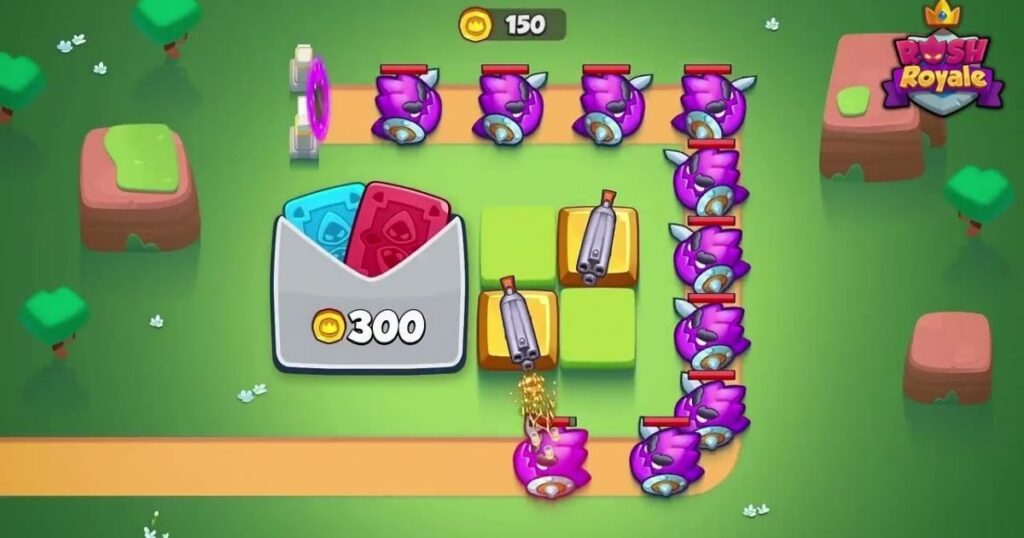
Combat scenarios are split into isolated lanes where monster waves emerge from spawning portals and advance toward the player’s castle gates. Real-time multiplayer configurations are supported across both highly competitive player-versus-player modes and collaborative co-op environments.
Rush Royale Game Modes & Rotating Competitive Events
Beyond standard rank-match loops, high user retention is sustained by Rush Royale through automated clan architectures, collaborative tournament structures, and a constantly rotating calendar of time-limited competitive events.
1. Competitive PvP & Plunder Mechanics
In standard PvP matching arrays, every monster eliminated on a player’s side is instantly transferred to the opponent’s lane, thereby escalating combat velocity. Rounds are systematically concluded with a specialized boss wave, through which the structural integrity of the defensive layout is severely tested. During active Clan Wars, a specialized Plunder mechanic is utilized by players to deploy automated defender bosses against rival clan arrays, allowing player ranking points to be stolen upon a successful breach.
2. Specialized Event Modes
To prevent stagnation within the standard competitive meta, seasonal event brackets are introduced by the engine. Standard card inventories are limited during these events to isolate and test raw tactical adaptation.
Rush Royale Specialized Event Formats
| Event Classification | Mode Type | Deck Building Constraints & Core Rules |
| Rush for Glory | PvP (Competitive) | Temporary decks are constructed by the player through repeatedly choosing one card out of three random options presented by the engine. |
| Royal Trials | PvE (Progression) | Decks are assembled from personal inventories, but energy resources are systematically depleted after each battle, forcing deck rotation. |
| Mirror Decks | PvP (Identical Meta) | Both opponents are forced by the matching engine to fight using identical, pre-assembled card configurations to isolate tactical skill. |
| Dragon Rift | Clan PvE (Cooperative) | Group members pool resources to progress through distinct worlds, working collaboratively to deplete a massive health pool belonging to an end-world dragon. |
Rush Royale Economy, Factions, and Card Progression
Unit progression relies entirely on a foundational rarity tiering system broken down into four distinct categories: Regular, Rare, Epic, and Legendary. Baseline damage outputs and scaling efficiency are dictated by card level enhancements.
Upgrades and Gold Accrual
To upgrade a unit’s core statistical level, duplicate copies of the targeted card must be collected, and specific gold resources accumulated via co-op matchmaking must be spent.
The Talent and Ascension System
At key milestone thresholds, cards can undergo a process known as Ascension through the consumption of specialized Faction Cores. Combat strategies can be customized by the player through selecting between two interchangeable talents that fundamentally alter baseline card behaviors.
Faction Enhancements
All units are assigned to one of five thematic factions. A weekly rotation modifier is applied by the software engine, through which localized stat boosts and passive enhancements are granted to a specific faction to ensure a fluctuating card meta.
Cross-Platform Strategy & Hardware Requirements
As part of a broader corporate pivot toward independent global operations centered in Amsterdam, the operational footprint of Rush Royale was expanded beyond iOS and Android to capture desktop spaces via Microsoft Windows. Targeted technical optimization is required to maintain system stability across these platform vectors.
Microsoft Windows Desktop System Requirements
| Hardware Component | Minimum Technical Requirements | Recommended Technical Specifications |
| Operating System | Windows 10 (64-bit architecture) | Windows 10 / Windows 11 (64-bit) |
| Processor (CPU) | Intel Core i3-530 / AMD Athlon II X3 415e | Intel Core i5-3470 / AMD Athlon 240GE |
| System Memory (RAM) | 2 GB RAM | 4 GB RAM |
| Graphics Card (GPU) | NVIDIA GeForce 250 GTS / AMD Radeon HD 4850 | NVIDIA GeForce GTX 1050 Ti / AMD Radeon R9 380 |
| Storage Space | 1 GB available storage | 1 GB available storage |
The Pay-to-Win (P2W) Paradox: Community Sentiment
Despite the generation of $102 million in revenue over a single calendar year—which represented a massive 76% year-over-year surge—increasingly vocal community backlash regarding monetization structures is being faced by the development team.
Field reports and consumer feedback scraped from grass-roots hubs like Reddit reveal deep structural dissatisfaction among the long-term player base. This friction centers heavily on recent software updates, where a distinct transition toward a heavily monetized progression framework is highlighted by users.
The Festival of Talents Bottleneck
The core point of community frustration remains the restructuring of rewards during major live-ops events, such as the Festival of Talents. Historically, new baseline event units could be unlocked by free-to-play participants simply through completing the event ladder or spending accumulated event coins.
Recent system overhauls have systematically removed these tokens from the standard progression path. Instead, a strict progression wall is faced by users: to gain initial possession of an event unit, premium saved gems or real-world currency must be directly spent.
Community Voices
It is written by one player detailing the latest content updates that the game has entered a state where everything has become an expensive money grab. It is argued that while variety in deck building is claimed to be a priority by the developers, this philosophy is not reflected in the updates. It is asserted that long-term player retention, rather than sudden money grabs, is what ultimately yields sustainable income for the publisher.
This monetization shift has triggered organized consumer resistance, with segments of the community actively calling for structured event boycotts, refusal to purchase battle passes, and negative store reviews to pressure the development team into restoring constructive baseline rewards.
Premium Tier Monetization Framework
| Store Item / Service | Baseline Pricing | Core Rewards & Economic Impact |
| Epic Season Pass | $4.99 (Standard Tier) | Access is unlocked to additional reward ladders, seasonal resources, and basic progression caches. |
| Legendary Season Pass | $11.99 (Premium Tier) | Advanced progression boosts, item multipliers, and targeted rare reward drop pools are granted. |
| Hero Tavern Pass | $9.99 (Standalone) | Specialized access is offered to unique hero shards, cosmetics, and custom milestone currencies. |
| Hero Tavern Pass Bundle | $14.99 (Premium Pack) | Standard access is combined with an instant allocation of 2,100 specialized tavern coins. |
Analytical Verdict: Balancing Monetization with Player Retention
Ultimately, the crossing of the 50 million downloads milestone proves that the underlying hybridization of card collection and path defense mechanics is fundamentally sound. However, a critical crossroads is faced by MY.GAMES.
While microtransaction structures and premium passes are standard features within modern mobile software models, the over-gating of baseline character assets threatens vital user engagement loops. A continuous equilibrium between immediate commercial monetization and accessible progression pathways for free-to-play participants must be maintained if the competitive matchmaking ecosystem is to be sustained.
Frequently Asked Questions
Is Rush Royale completely pay-to-win?
While the tactical foundation relies heavily on player skill, board positioning, and managing merge randomness (RNG), high-tier competitive rankings are deeply influenced by real-money investments. Upgrading legendary cards and securing modern event units requires duplicate cards and premium resources that are highly gated behind microtransactions, putting free-to-play users at a numbers disadvantage in late-game PvP.
How are Legendary cards obtained efficiently without spending money?
Legendary cards can be obtained by free-to-play players through active participation in monthly season ladders, maximizing clan war tournament participation to hit division thresholds, and monitoring seasonal rewards. Additionally, underperforming legendary cards can be traded at the in-game Magic Lab in exchange for magic crystals used to target specific upgrades.
What is the Trainer hero used for in the game?
The Trainer is the entry-level hero assigned to all players during the initial tutorial phase. The Trainer’s active ability deploys an explosive straw dummy onto the track, which completely blocks the advancement of enemy monster waves for a brief duration, giving your defensive line extra time to burn down high-health targets or boss units.
Can Rush Royale be played on a low-end desktop or laptop?
Yes. The minimum desktop specifications require only an Intel Core i3-530 processor, a basic DirectX-compatible graphics card (like the GeForce 250 GTS), and 2 GB of RAM. The game is highly optimized for low-spec configurations and occupies just 1 GB of hard drive space.