

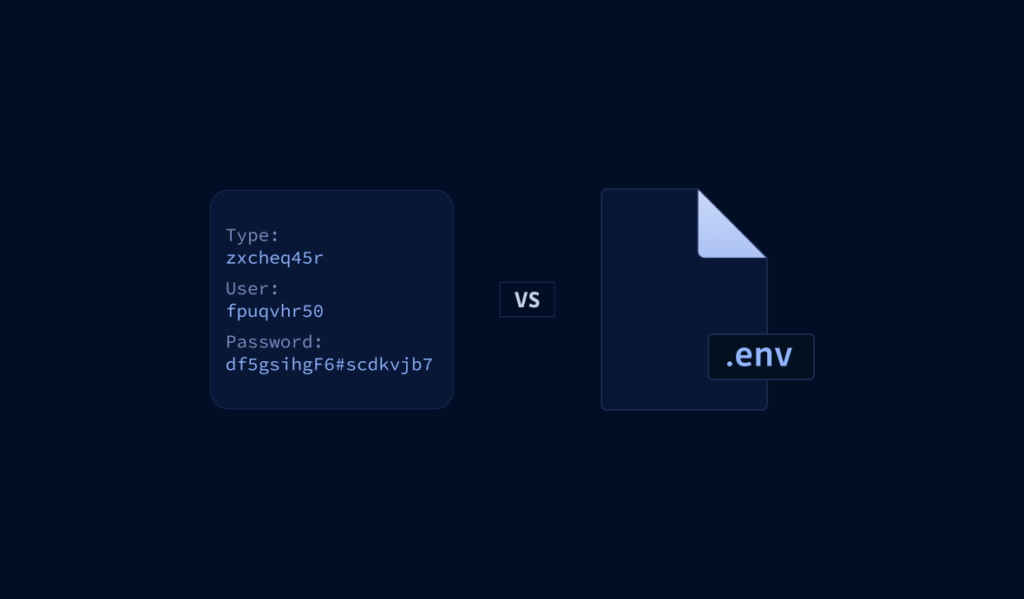
Modern serverless architectures and microservices rely on environment configuration files—most commonly named .env—to declare dynamic system attributes. Because server-side frameworks must communicate seamlessly with databases, payment portals, and third-party APIs, developers use these hidden files to supply credentials to the application layer.
However, if an inbound web server is misconfigured or a deployment pipeline fails to apply correct perimeter permissions, this unencrypted file can become exposed to the public internet. This exposure allows threat actors to harvest long-lived secrets using simple automated web scraping requests.
The Data Exposure Pipeline
[Unsecured Web Server] ──► Public Ingestion Request (/.env) ──► Cleartext Key Leak ──► Control Plane Takeover
The Anatomy of an .env File Exposure
A .env file is natively treated as a hidden asset within UNIX-based filesystems. However, unless explicit blocks are defined within the web server routing configuration (such as Apache .htaccess directives or Nginx location blocks), a remote user can query the asset directly via a standard browser request: [https://example.com/.env](https://example.com/.env).
When delivered by a misconfigured server, the variables are rendered in an unencrypted, cleartext format:
# Example of a Vulnerable Public Production Configuration
ENV="PRODUCTION"
LOG_LEVEL="INFO"

# Third-Party SMTP Email Ingestion Access
SMTP_HOST="email.cybertechbiz.com"
SMTP_PORT=587
SMTP_USER="alerts@cybertechbiz.com"
SMTP_PASS="HardcodedProductionSecretPassword2026!"

# Production Core Database Access Vector
DB_HOST="internal-db.cybertechbiz.com"
DB_DATABASE_NAME="enterprise_ledger"
DB_USER="app_root_admin"
DB_PASSWORD="UnencryptedDatabaseKeyString2026"

# Cloud Infrastructure Control Token
AWS_ACCESS_KEY_ID="AKIAIOSFODNN7EXAMPLE"
AWS_SECRET_ACCESS_KEY="wJalrXUtnFEMI/K7MDENG/bPxRfiCYEXAMPLEKEY"
If an attacker captures this data pool, the perimeter of the application layer is entirely bypassed. The threat actor drops below the web stack and moves directly into your data stores, mail relays, and cloud control planes.
Mass-Scraping Dynamics: From 2.6M to 230M Targets
Independent security scans reveal how trivial it is for malicious actors to locate these files at scale. In a localized country-level diagnostic scan covering 2.6 million domains, security researchers isolated 201 exposed .env files using a basic multithreaded automation script.
The cleartext data breakdown from that single baseline batch included:
- 135 core database root usernames and passwords.
- 48 active SMTP mail accounts with credentials.
- 11 production API tokens for billing/payment platforms (such as Stripe and PayPal).
- 128 app secrets used to generate session IDs, CSRF tokens, and JSON Web Tokens (JWT).
This attack framework has scaled rapidly. Advanced cloud extortion syndicates now deploy automated scanning infrastructure across hundreds of millions of domains. In a massive campaign evaluated by global threat intelligence teams, threat actors set up attack clusters across multiple compromised AWS environments, using automated tasks to cycle through more than 230 million unique targets.
This coordinated campaign successfully targeted 110,000 domains concurrently, extracting over 90,000 unique configuration variables from exposed .env files. Of those scraped assets, 7,000 keys belonged straight to corporate cloud services, while 1,500 leaked absolute access to integrated corporate social media accounts.
The Threat Matrix: Baseline Scans vs. Advanced Cloud Extortion
To assist security teams in understanding the scale of this threat vector, the following matrix compares baseline scanning operations against industrial-scale extortion syndicates.
| Technical Attribute | Independent Scans (Baseline Vector) | Coordinated Extortion Syndicates (Advanced Threat Analysis) |
| Ingestion Scale | 2.6 Million Country-Level Domains | 230+ Million Global Targets |
| Execution Vehicle | Single-threaded automation script | Automated cloud-based parallel task looping |
| Exploitation Goal | Vulnerability proof-of-concept / API gathering | Exfiltration, object deletion, and active extortion |
| Infrastructure Pivot | Direct credential misuse (Database/SMTP) | Privilege escalation to administrative cloud control roles |
| OPSEC Category | Open, single-origin residential/commercial nodes | Multi-source routing: Tor nodes, VPN exits, and proxy VPS |
| Final Payload Impact | Isolated configuration leaks and point-of-entry compromises | Production storage erasure followed by active ransom uploads |
Legacy Scrapers vs. Modern Coordinated Bot Campaigns
This data hierarchy underscores a critical reality: form and endpoint automation abuse is an escalating threat profile. During landmark historical investigations into regulatory notice-and-comment web pipelines, forensic data analyses revealed that automated bot loops routinely hijacked public discourse. While legitimate user commentary dominated unique human submissions, massive, highly duplicative blocks of form letters generated by simple scripts flooded data intake pipelines to mask true human intent.
Those legacy campaigns weaponized rudimentary mail-merge tools to disguise 1.3 million submissions as unique, grassroots entries by programmatically swapping synonyms into a structured template.
Coordinated Automated Script Footprint
Ultimately, out of tens of millions of entries, less than 4% were found to be truly unique, organic human submissions. This legacy behavior demonstrates that automated script operations have always targeted web forms to dilute verification processes. If simple synonym-swapping, mad-lib scripts could bypass public ingestion systems in the past, modern large-scale automation frameworks targeting cleartext server architecture present an absolute systemic risk to digital enterprise assets.
Infrastructure Reality: The Generative Automation Boom
The modern threat model has shifted dramatically. In the past, detecting automated networks relied on identifying static mail-merge footprints, basic keyword patterns, or repetitive string hashes. Today, the democratization of hyper-realistic, low-cost generative automation has completely broken legacy signature defense frameworks.
Modern bad actors no longer need to rely on predictable search-and-replace synonym tables to manufacture high volume. Current threat vectors leverage fine-tuned automated deployment models capable of generating millions of structurally distinct, legally cogent scripts, complete with deliberate human-like variations and unique synthetic background personas. When deployed across public notice portals, these campaigns render traditional text-clustering and duplicate-detection algorithms entirely obsolete, making automated astroturfing cheap to scale and incredibly difficult to trace.
Anatomy of a Cloud Control Plane Takeover
When extortion networks extract an Identity and Access Management (IAM) key pair from an exposed .env file, they systematically pivot through the following threat vectors:
1. Discovery (MITRE ATT&CK TA0007)
The automated script immediately runs identity token API calls, such as GetCallerIdentity. This serves as an automated verification tool to read the account number, User ID, and Amazon Resource Name (ARN) of the compromised credential. Once verified, the script executes commands to enumerate your storage layout and identify future target identities for lateral movement.
For enterprise security leaders, tracking how these shifting threat vectors impact high-level compliance has become a top priority, a trend explored deeply in our recent CISO boardroom report.
2. Privilege Escalation (MITRE ATT&CK TA0004)
If the stolen credential has permissions to edit account paths, the actor triggers a CreateRole API call to manufacture an internal role named lambda-ex. They then pass an AttachRolePolicy Request to bind the standard managed AdministratorAccess policy to that role, granting themselves total structural control over the cloud environment.
3. Execution & Exfiltration (MITRE ATT&CK TA0002 / TA0010)
With admin status secured, the attackers drop an automated bash script into serverless function blocks. They deploy this function into every enabled region across your cloud console within seconds. The function downloads an updated list of target IP addresses from an external storage node and forces your own cloud infrastructure to scan the rest of the web, turning your server network into a weaponized staging ground.
Concurrently, the threat actors deploy advanced storage tools to run extensive bucket audits. They pull your proprietary enterprise tables down through an unmonitored exit path and execute automated deletions across your production nodes.
These transparent automated scripts operate on basic pattern execution—much like the legacy vulnerabilities system administrators face when patch management slips, such as the risks detailed in our blueprint on securing the Windows print spooler.
4. Impact (MITRE ATT&CK TA0040)
Once your object data is completely erased, the syndicates upload a single target object to your empty storage environment: a text asset containing a ransom note demanding payment to prevent the leakage or sale of your data assets on the dark web.
Defensive Engineering and Hardening Protocols
Securing your infrastructure against environment file exploitation requires implementing strict server blocks, architectural restructuring, and deep log monitoring.
1. Web Server Rule Hardening
Prevent your web server from serving dot-files under any circumstances. Implement these configurations immediately based on your environment:
For Nginx Platforms:
Place this location block inside your active server directory console:
# Explicitly block access to hidden environment settings files
location ~ /\.(env|git|htaccess) {
    deny all;
    return 404;
}
For Apache Environments:
Ensure your server root permits processing overrides, and inject this string into your top-level .htaccess document:
# Block any public inbound traffic targeting .env configurations
RedirectMatch 404 /\.(env|git|bak)$
2. Move to Temporary IAM Role Credentials
Stop storing long-lived, hardcoded access tokens within web root directory structures. If your application code is deployed on an virtual machine instance or inside a serverless wrapper, configure an explicit IAM Instance Profile or an IAM Role execution policy. Your code will automatically fetch short-lived, self-rotating tokens from the local metadata service, meaning that even if an .env file is accidentally exposed, there are no permanent secrets inside for an attacker to steal.
3. S3 Asset Visibility Tracking via Cost Reports
If detailed cloud storage object-level logs are disabled due to data retention limits, use Cost and Usage Reports to isolate data breaches. Security operations teams can set up alerts for sudden, atypical spikes in high-volume bucket usage metric aggregates:
Anomalous Cost Report Footprint
[API: GetObject] ──► Massive Outbound Byte spike (Exfiltration Event Indicator)
[API: DeleteObject] ──► Sharp Drop in Total Volume (Active Erasure/Extortion Step)
By identifying these hourly or daily spikes early, you can lock down your permissions before the system is fully compromised.
Enterprise Threat Hunting Queries
Run these specific hunting diagnostics inside your security operations consoles to flag unauthorized account manipulations and infrastructure deployment changes:
Cortex XQL Security Discovery Query
// Scan cloud event tracking logs for administrative privilege manipulation events
dataset = amazon_aws_raw
| filter eventName in ("CreateRole", "AttachRolePolicy", "CreateSecurityGroup", "AuthorizeSecurityGroupIngress", "CreateFunction20150331")
| fields awsAccountId, actorUserArn, sourceIpAddress, eventName, requestParameters
Prisma Cloud RQL Audit Query
// Identify unusual role configuration changes and lambda deployment actions within cloud pipelines
event from cloud.audit_logs where cloud.type = 'aws' AND cloud.service = 'iam.amazonaws.com' AND operation IN ('CreateRole', 'AttachRolePolicy', 'CreateFunction20150331', 'RunInstances') ADDCOLUMN $.userAgent $.requestParameters.roleName $.sourceIpAddress
Frequently Asked Questions (FAQ)
Is an exposed .env File a security vulnerability in WordPress or Laravel?
No. An exposed environment configuration is an infrastructure deployment misconfiguration, not an inherent application-level code flaw. It occurs when a web server’s routing rules fail to protect files starting with a dot, allowing them to be served as public static assets.
How can I verify if my website’s .env files are publicly readable?
Open an anonymous browser tab and navigate directly to your root domain with the file extension added: [https://yourdomain.com/.env](https://yourdomain.com/.env). If the request returns a 404 Not Found or 403 Forbidden status page, your web directory server rules are working correctly. If it displays your database names or plain-text access keys, your server configuration is vulnerable.
Can automated security scanners fix an exposed environment configuration automatically?
No. Diagnostic security systems can run scanning templates to alert you if a file is exposed to the public internet, but fixing the leak requires a system administrator to update the active Nginx or Apache server routing blocks manually.