

As federal agencies take increasingly stringent actions to limit the spread of crisis situations, individual citizens and corporate entities rely heavily on public digital channels to voice their experiences. For enterprise security leaders, tracking how these shifting regulatory pipelines impact high-level compliance has become a top priority, a trend explored deeply in our recent CISO boardroom report. When fast-tracked federal rules—ranging from travel restrictions to heightened state-level surveillance—require an expansion of centralized state powers, administrative laws require the government to post these provisions publicly.
Under the statutory framework of the Administrative Procedure Act of 1946 and the e-Government Act of 2002, federal entities must host online notice-and-comment windows to receive public feedback before finalizing rules. Multiple milestone judicial precedents have affirmed that an agency must explicitly demonstrate it evaluated, indexed, and addressed these public submissions rather than simply archiving them. This legal baseline has been defended across decades of administrative litigation, including:
- Citizens to Preserve Overton Park, Inc. v. Volpe, 401 U.S. 402, 416 (1971)
- Home Box Office, Inc. v. FCC, 567 F.2d 9 (D.C. Cir. 1977)
- Thompson v. Clark, 741 F.2d 401, 408 (D.C. Cir. 1984)
However, this foundational institution of democratic feedback remains fundamentally vulnerable to automated bot attacks.
The Medicaid Deepfake Text Experiment
To test the boundaries of public comment security, researchers Jinyan Zang, Max Weiss, and Latanya Sweeney from Harvard University’s Data Privacy Lab conducted a study using publicly available artificial intelligence architectures. The team generated 1,001 unique deepfake text entries—machine-generated strings explicitly tailored to mimic human semantic structures—and submitted them to a live Centers for Medicare & Medicaid Services (CMS) website regarding proposed mandatory work reporting requirements for citizens on Medicaid in Idaho.
Plaintext
Payload Split: Deepfake Bot Comments vs. Authentic Submissions
[█████████████████████░░░░░░░░░░░░████]
Deepfake AI Comments: 1,001 (55.3%)
Authentic Human Comments: 809 (44.7%)
Total Indexed Submissions: 1,810
The synthetic comments quickly comprised over 55% of the total public record. In a subsequent follow-up study, the researchers asked individuals to identify whether a bot or a human wrote the comments. Respondents scored an average accuracy rate of exactly 50%. This mirrors the statistical probability of a random coin flip, proving that modern generative models can effortlessly bypass human verification filters. While the academic researchers immediately flagged and withdrew these deepfake elements from the public record, malicious actors operate under no such ethical boundaries.
The Evolution of Form Exploits: 2017 vs. 2026
To understand why traditional firewalls fail against modern automated text generation, we must analyze how the underlying threat vectors have evolved over the last decade.
| Feature / Metric | Legacy Bot Campaigns (2017 Net Neutrality) | Modern Deepfake Campaigns (2026 Generative AI) |
| Primary Technology | Mail-Merge & Regex Synonym Tables | Advanced Neural Networks & Fine-Tuned Local LLMs |
| Structural Output | Conspicuous, repetitive sentence structures | Hyper-realistic, distinct paragraphs with unique syntax |
| Total Attack Volume | Over 21 Million faked comments (96%+ of the record) | Capable of scale matching server resource thresholds |
| Detection Vulnerability | Easily flagged via standard string-matching/MD5 hashes | Bypasses traditional text-clustering & semantic filters |
| Human-Mimicry Level | Low (Stilted language, uniform tone, obvious signatures) | Elite (Includes organic semantic drift & typos) |
| Identity Footprint | Scraped registries (Stolen names of deceased/fictional figures) | Dynamic, programmatically manufactured synthetic personas |
Legacy Scrapers vs. Modern Coordinated Bot Campaigns
This data hierarchy underscores a critical reality: form automation abuse is no longer a simple script problem. During the landmark 2017 FCC net neutrality repeal proceedings, a forensic data analysis by Jeff Kao revealed that a massive automated infrastructure loop hijacked public discourse. While legitimate user commentary dominated the long tail of unique submissions, massive, highly duplicative blocks of form letters flooded the agency’s data intake pipelines to mask true public intent.
The campaign weaponized rudimentary mail-merge tools to disguise 1.3 million comments as unique, grassroots submissions by programmatically swapping synonyms into a structured template. These transparent automated scripts operate on basic pattern execution—much like the legacy vulnerabilities system administrators routinely face when patch management slips, such as the risks detailed in our blueprint on securing the Windows print spooler. If simple synonym-swapping mad-lib scripts could dilute a federal policy outcome, modern large language models pose an existential risk to public digital assets.
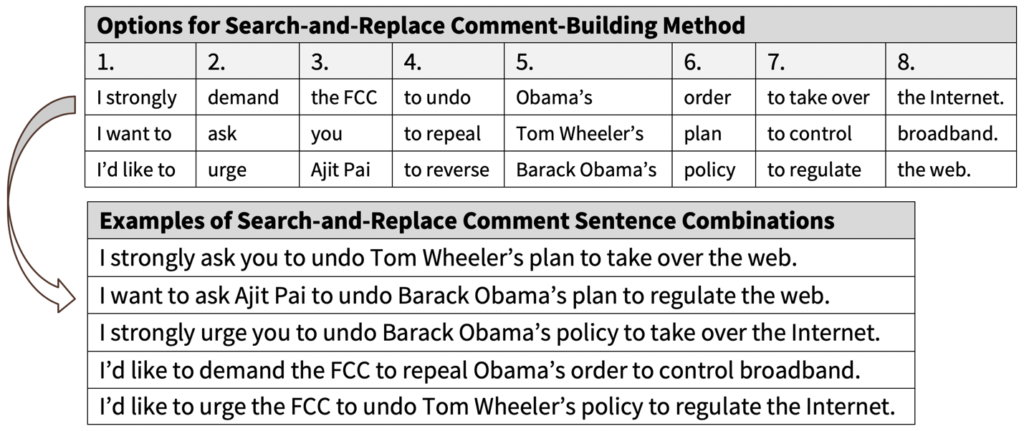
Ultimately, out of more than 22 million comments submitted to the FCC, less than 800,000 (roughly 3-4%) were found to be truly unique, organic public submissions. Within those verified organic comments, old-school statistical sampling established a ground truth: 99% of actual human respondents supported keeping net neutrality regulations.
Despite clear evidence of identity theft and automated astroturfing, the regulatory body accepted the tainted data pool into the official record. If simple synonym-swapping mad-lib scripts could dilute a federal policy outcome, modern large language models pose an existential risk to public digital assets.
2026 Infrastructure Update: The Generative AI Boom
As highlighted in the comparison matrix above, the threat model has shifted dramatically. In 2017, detecting bot networks relied on identifying static mail-merge footprints, keyword patterns, or repetitive string hashes. Today, the democratization of hyper-realistic, low-cost generative APIs has completely broken legacy defense frameworks.
Modern bad actors no longer need to rely on predictable search-and-replace synonym tables to manufacture volume. Current threat vectors leverage fine-tuned local models capable of generating millions of structurally distinct, legally cogent essays, complete with deliberate human-like typographical errors, organic semantic drift, and unique synthetic background personas. When deployed across public notice portals, these campaigns render traditional text-clustering and duplicate-detection algorithms entirely obsolete, making automated astroturfing cheap to scale and incredibly difficult to trace.
Engineering Technology Defenses for Online Form Ingestion
Resolving the deepfake text dilemma requires deploying automated defensive controls at two primary technical stages: Inbound Ingestion and Post-Crawl Acceptance.
1. Inbound Ingestion Hardening
Implementing modern, behavioral-based CAPTCHA frameworks helps rate-limit large-scale, distributed API bot flooding. However, simple visual or audio puzzles fail against attackers willing to pay for low-cost labor abroad to solve the entry challenges manually.
A more robust architectural fix requires integrating strict cryptographic user authentication. By separating the identity verification phase from the comment transmission phase using zero-knowledge proofs, platforms can validate that a user is an authenticated human while preserving their statutory right to anonymous submission. This strategy protects identity assets on highly sensitive platforms, such as the FDA or CMS healthcare panels.
2. Post-Crawl Processing and Adversarial ML
For data that passes initial firewall checks, systems must deploy advanced classification models to analyze content structures for machine-generated markers. This sets up an ongoing arms race between natural language generation frameworks and detection algorithms.
As automated rule-making updates expand across environmental protection registries, distance learning models, and public safety spectrum allocations, leaving public forms unhardened invites catastrophic data pollution. Securing these local hardware endpoints and software perimeters requires a steady pipeline of specialized cybersecurity talent, an asset built directly through standardized training regimens like the [top offsec certifications] honored across the industry today.
Frequently Asked Questions (FAQ)
What is the difference between legacy form-letter spam and modern deepfake text?
Legacy spam campaigns use explicit “search-and-replace” synonym scripts (mail-merging) to build text variations from a static template. Modern deepfake text uses generative neural networks to write completely unique, dynamic paragraphs from scratch, mimicking human tone, context, and grammar without relying on a recognizable template.
Why do federal agencies accept fake or bot-submitted comments?
Many public notice-and-comment infrastructure setups lack the verification frameworks required to securely validate human identities. Because agencies prioritize accessibility and legal mandates to accept anonymous public input, they often lack the technical resources or statutory authority to filter out algorithmically generated comments from their databases.
How can security teams verify human entries without destroying user privacy?
The optimal solution is splitting the database pipeline using Zero-Knowledge Proofs (ZKPs). This architecture allows an independent third-party system to verify a citizen’s identity or human behavior profile, then pass an anonymized cryptographic token to the public record portal. The portal accepts the comment knowing it came from a real human, without caching any identifying personal data.